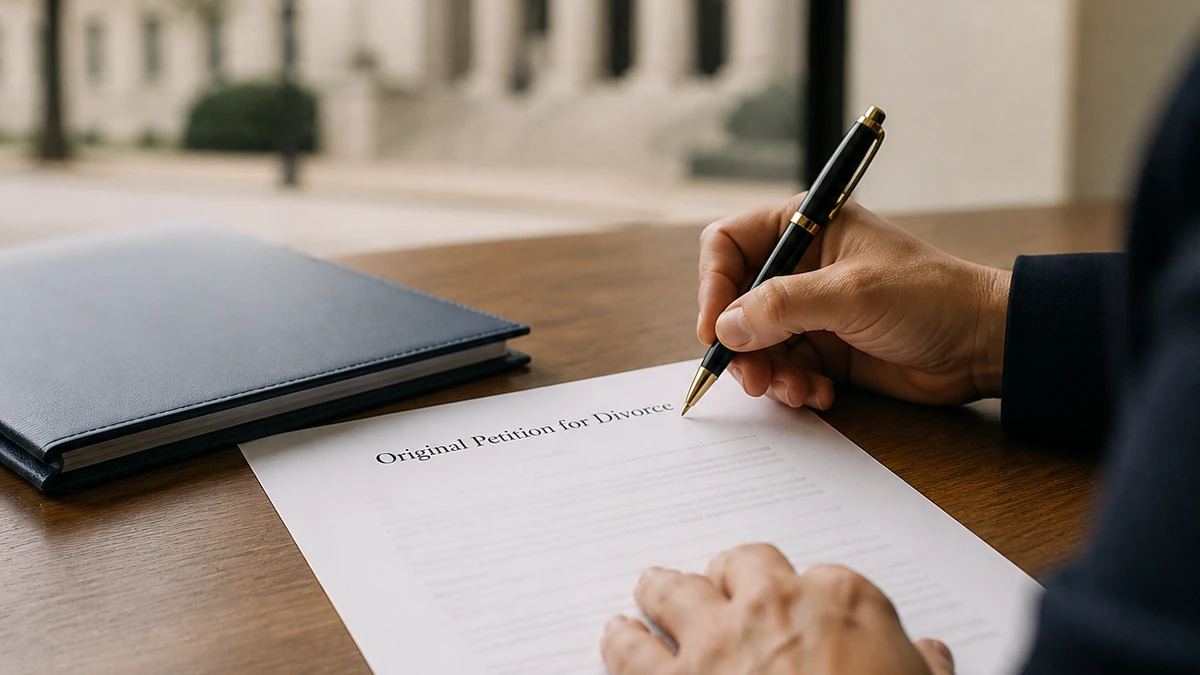
To file for divorce in Texas, one spouse files an Original Petition for Divorce in the district court of the county where either spouse has lived for the last 90 days, after at least six months in Texas. The other spouse is served or signs a waiver, the court can set temporary orders, and the divorce cannot be finalized until 60 days after filing. If you’re wondering how to file for divorce in Texas, here is each step as it happens in Harris, Fort Bend, and Montgomery County, and what you need before you start.
Before You File: Texas Divorce Requirements
Ending a marriage can be a difficult decision. Along with the emotional challenges, the legal process can feel confusing, especially when you are uncertain where to begin.
If you are planning to file for divorce in Texas, it helps to learn about the basic requirements before taking the first step. There are two things to review: whether you meet the residency rules and which legal ground you will use to request a divorce.
Texas Residency Requirements: Six Months in the State and 90 Days in the County
If you are thinking about filing for divorce in Texas, one of the first things to check is whether either spouse meets the state’s residency requirements. Under Texas Family Code § 6.301, at least one spouse must have lived in Texas for six months and in the county where the divorce will be filed for 90 days.
Confirming the correct filing location before submitting your paperwork can help you avoid unnecessary delays.
Understanding Insupportability: Texas’s No-Fault Divorce Ground
The Texas divorce process does not require one spouse to prove that the other did something wrong. Couples can file for a no-fault divorce when the marriage can no longer continue. In Texas, this is commonly based on insupportability under Texas Family Code § 6.001. It means ongoing differences or conflicts have made it impossible for the spouses to repair their relationship.
Step 1: File the Original Petition for Divorce in Texas
Filing an Original Petition for Divorce is the first formal step in ending your marriage through the Texas court system. The petition explains your request for a divorce and identifies the issues that may need to be resolved before the court can finalize your case.
What Is an Original Petition for Divorce
An Original Petition for Divorce is a legal document that starts your divorce case. It includes the basic details about both spouses and the marriage, along with requests for the court to address matters such as property division, debts, child custody, and support, depending on the circumstances.
Where to File for Divorce in Harris, Fort Bend, and Montgomery Counties
You file in the district court of the county where you or your spouse has lived for at least 90 days, as long as one of you has lived in Texas for at least six months. The filing location depends on your county:

- Harris County: Harris County Family Law Center, 201 Caroline St, Houston
- Fort Bend County: Fort Bend County Justice Center, 1422 Eugene Heimann Circle, Richmond
- Montgomery County: Montgomery County Courthouse, Conroe
Divorce cases are generally handled by district courts, and some counties also use county courts at law. Most petitions are now submitted online through eFileTexas. The clerk’s office can provide filing instructions, fee information, and guidance on submitting your documents.
What Happens After You File
- The court processes your petition.
- Your spouse receives legal notice.
- Both parties address outstanding issues.
- You negotiate terms or attend hearings.
- You complete the required waiting period and follow the necessary legal procedures.
- The judge signs the final divorce decree.
Step 2: Serve Your Spouse or File a Waiver of Service
After filing, you must notify your spouse through formal legal service or obtain a properly completed waiver of service. The right option depends on your situation and whether your spouse is willing to cooperate.
How to Serve Divorce Papers in Texas
Your spouse receives official notice of the divorce case and has an opportunity to respond. You generally cannot serve the papers yourself. The divorce papers are usually delivered by a sheriff, constable, or authorized process server.
What Is a Waiver of Service
In a Texas divorce, a waiver of service can make the process simpler. It is used when both spouses already know about the case and want to avoid formal delivery of the divorce papers. Your spouse signs the waiver, usually before a notary, and it is filed with the court.
What Happens if Your Spouse Does Not Respond
If your spouse does not respond by the deadline, you must still meet the legal service rules and provide the required proof to the court. The court then decides whether the divorce can proceed without your spouse’s participation. We cover this in more detail in our post on what happens when your spouse doesn’t respond to divorce papers in Texas.
Step 3: Request Temporary Orders During Your Divorce
Temporary orders can help establish clear responsibilities for the family home, household expenses, and child custody while the divorce is pending. You may also request temporary orders to address urgent issues before the final decree.
Who Stays in the Family Home
One spouse may remain in the marital home during the divorce. The court reviews the circumstances of the case before deciding whether one spouse should have exclusive use of the property.
Who Pays Bills and Household Expenses
Mortgage payments, rent, utilities, and other bills still need to be paid during a divorce. The judge may issue temporary orders addressing mortgage or rent payments, utilities, insurance, and other household expenses until the divorce is resolved.
Where Will the Children Live While the Case Is Pending
Children need a stable routine during a divorce. Temporary orders can set a parenting schedule, determine where the children will live, and outline each parent’s responsibilities until the court makes final decisions.
Step 4: Complete Disclosures, Discovery, and Mediation
The divorce process involves several steps beyond filing the initial paperwork. Spouses may need to exchange relevant information, review financial records, and explore ways to resolve their differences.
Sharing Financial and Property Information
- Disclose income, bank accounts, debts, and other financial details.
- Identify marital assets, including homes, vehicles, and investments.
- Keep records accurate and complete to avoid unnecessary disputes.
How Discovery Works in a Texas Divorce
Discovery is how each spouse obtains the information needed to understand the case. It may include document requests, written questions, and other formal requests allowed under Texas rules. Reviewing these details can help clarify the issues that need to be resolved before the divorce is finalized.
Can Mediation Help You Reach an Agreement
Mediation can resolve disputes over property, finances, and child-related matters without a full trial. It gives both spouses an opportunity to work toward an agreement with help from a neutral third party.
Step 5: Reach an Agreement or Go to Trial
When both spouses agree on the main matters, they can often complete the divorce process without a trial. If disagreements remain, a judge may need to make the final decisions. Resolving as many issues as possible can help make the process more manageable.
Finalizing an Agreed Divorce
When you have submitted the necessary documents and the judge has reviewed your case, your divorce can be finalized with the judge’s signature on the decree, subject to Texas divorce requirements.
What Happens During a Contested Divorce Trial
If the spouses cannot resolve important issues, the divorce goes to trial. The judge reviews the evidence from both sides before making decisions. The outcome may cover finances, property, child custody, and support. Both spouses have to follow the court’s final orders once the judge makes a decision.
Understanding the Final Decree of Divorce
The Final Decree of Divorce covers matters such as property and debt division, child custody, visitation, and support when applicable. Following the decree helps both spouses understand their legal obligations.
How Long Does a Divorce Take in Texas
The time it takes to finalize a divorce in Texas depends on how quickly both spouses agree on the main issues. An agreed divorce may move forward soon after the 60-day waiting period, while a contested case can take much longer. See our full Texas divorce timeline guide for what to expect.
Understanding the 60-Day Waiting Period
Most divorces cannot be finalized before the 60th day after filing. Under Texas Family Code § 6.702, couples generally have to meet the Texas divorce waiting period even when both spouses agree on the terms. Exceptions are available in certain family violence cases.
What Can Delay or Extend the Divorce Process
Some of the main reasons a divorce takes longer:
- Disagreements about child custody or support.
- Disputes over property, debts, or finances.
- Delays in sharing required documents.
- Difficulty reaching a settlement through mediation.
- Court scheduling issues or a contested trial.
How Much Does It Cost to File for Divorce in Texas
Before filing for divorce in Texas, take time to review the expected expenses. Filing fees are [Harris County filing fee] in Harris County, [Fort Bend County filing fee] in Fort Bend County, and [Montgomery County filing fee] in Montgomery County. Your budget may also need to cover [attorney’s fees] and additional court costs of [additional court costs]. The total will vary depending on your case. For a full breakdown, see our guide to how much a divorce costs in Texas.
Final Thought
Filing for divorce may seem confusing at first, especially if you are unfamiliar with the legal requirements. Knowing what comes next and getting the right guidance can help you move through each step with greater confidence.
Philip Family Law Firm will help you understand your options during the divorce process. Our team will make sure you meet the filing requirements, handle service of process, request temporary orders, and complete the steps needed to finalize your divorce.
CTA: Contact us today to discuss your divorce concerns.
FAQs
Do I have to prove fault to get a divorce in Texas?
No. Texas allows no-fault divorce based on insupportability.
Can I file for divorce in Texas if my spouse lives in another state?
Yes. You can file if you meet the Texas residency requirements.
How long after filing can a Texas divorce be final?
Usually, Texas divorces have a mandatory 60-day waiting period after filing.